
Hongluck Robotics
HL-One
Perfect pasta, stir fry, eggs, and more.
HL-One is our precision unit. It turns a skilled cook's execution into a repeatable program — heat, agitation, and timing adjusted together in real time, so the plate no longer depends on who is on the line tonight. It occupies a single burner footprint and runs on 208-240V with no kitchen rebuild.
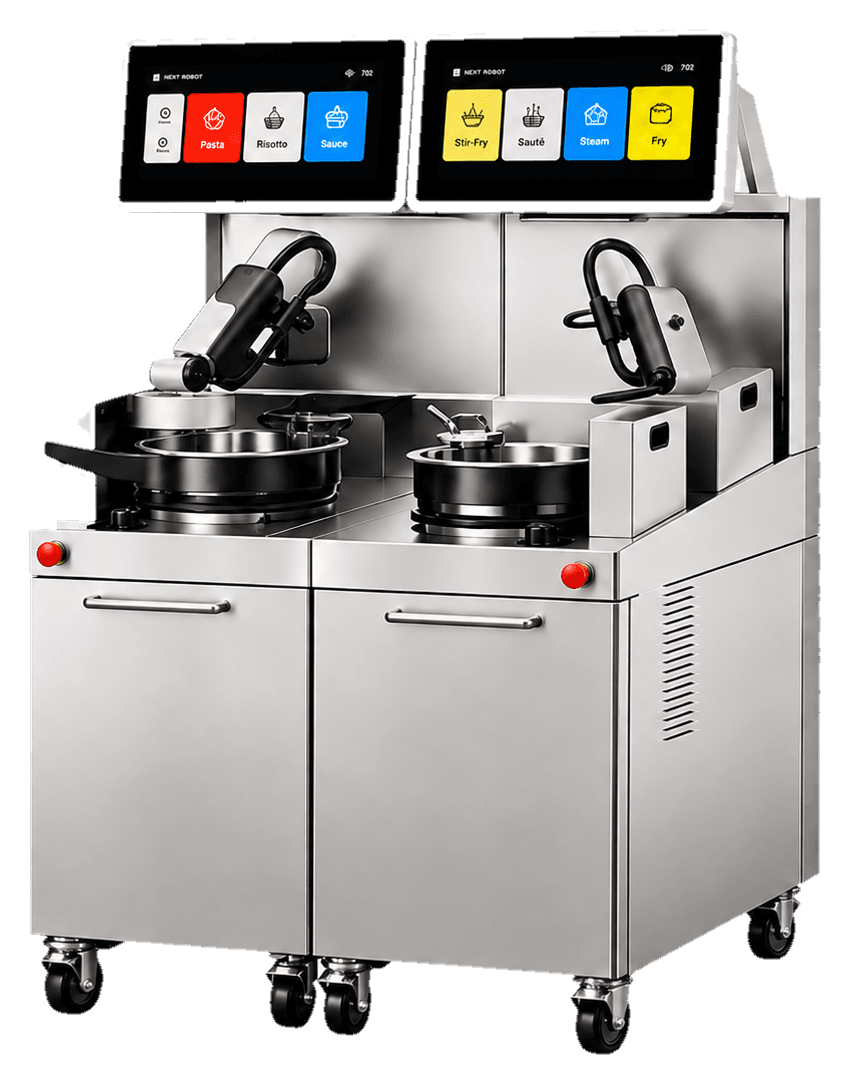
Core cooking system
Closed-loop execution
Not a fixed program: the pan state is read every 200 ms and heat, agitation, and remaining time are adjusted live.
Vision + thermal sensing
Patent pendingA camera reads color and volume while thermocouples track the pan curve — the same dish holds even when the produce varies.
Heat scheduling
Patent pendingHeating, agitation, and dosing share one timeline, so nothing arrives at the pan late during a hard sear.
Multiple cooking modes
Boil, stir-fry, sear, braise, and reduce combine into programs of up to 12 steps.
Integrated sauce finishing
Heating, mixing, and reduction in one pass, held to a target consistency rather than judged by eye.
Kitchen automation and workflow
Staged temperature control
Each stage holds its own band, within ±3°C.
Motion-controlled agitation
Speed and path change per step for even heat and proper emulsification.
Custom cooking sequences
Recipes are software-defined workflows; changing a parameter never means changing hardware.
System monitoring
Throughput, cook state, and machine health stream live, with alerts pushed to the manager's phone.
POS / KDS integration
Tickets arrive and are prioritized automatically, and one order can be split across several machines.
Ease of use
Touch interface
Frequent recipes sit on the first screen — two taps from ticket to start.
Cloud recipe library
Edit once at HQ and deploy to every machine in every location, with version rollback.
Status display
Remaining time, current step, and next action stay on screen so new staff never have to ask.
Multilingual UI
English and Chinese out of the box for mixed-language teams.
Performance and productivity
Consistent output
Portion and doneness hold across shifts, independent of individual skill.
Less manual intervention
Two staff actions per cycle: load and plate.
One operator, several machines
Machines queue their next action, so a single person can run a bank of units.
Much shorter training
New staff work solo after about two hours, against roughly three months for a traditional wok station.
Precise dosing
Ingredients are dosed by the gram, which caps food-cost drift directly.
Maintenance and reliability
Preventive monitoring
Sensors and algorithms flag wear before failure, turning downtime into planned service.
Tool-free teardown
Every food-contact part comes off for cleaning without tools.
Auto calibration
Temperature and motion zero points are checked at every start-up.
Stainless steel body
Food-grade stainless, built for wash-down and grease.
OTA updates
Algorithms and recipes update remotely — no service visit required.
Food safety and compliance
Temperature traceability
Every portion's heat curve is archived and exportable for inspection.
Enclosed cooking chamber
Lower cross-contamination and splatter risk; the cooking chamber keeps open flame away from the operator.
Certification in progress
TODO(content): NSF / CE / CCC claims must match certificates actually issued — do not publish before they are.
Spec sheet
- Rated power
- 7 kW (placeholder — confirm with engineering)
- Voltage
- 208-240V
- Batch capacity
- ≤ 2 kg (placeholder)
- Throughput
- ~60 portions/hour (placeholder)
- Dimensions
- 400 × 840 × 1765 mm (placeholder)
- Weight
- ~150 kg (placeholder)
- Cleaning
- Tool-free teardown + manual rinse
Ideal use cases
- Made-to-order restaurants and bistros
- Pasta, risotto, wok dishes, and sauces
- Pizzerias and fast casual
- Convenience stores and grab-and-go hot food
- Fuel stations and other compact kitchens
- Short-staffed sites that still need high quality
See it cook. Book a live demo.
See what AI-directed cooking looks like in a real kitchen.